Some family members might be interested to learn that 19 Pond Street, the “Grandma Riley house,” was sold last September for $449,000.
The seller was Yi Goo, and the buyer was 19PondSt, LLC. Time marches on.

It looks a bit different nowadays

Some family members might be interested to learn that 19 Pond Street, the “Grandma Riley house,” was sold last September for $449,000.
The seller was Yi Goo, and the buyer was 19PondSt, LLC. Time marches on.
It looks a bit different nowadays
It was on this May 28th day in 1862 that Patrick Riley and Rose Kiernan set foot in the United States.
Patrick and Rose first left Ireland and traveled to Liverpool, England. I do not know how long they stayed in Liverpool. It was typical for the emigrating Irish to first book passage to Liverpool, where they would hopefully gain employment and secure enough money to purchase passage to New York. Patrick and Rose did not process through Ellis Island because it was not established as an arrival center. We can determine they traveled in steerage class because the passenger list had them in the last group departing the ship.
It appears they were not married at the time because Rose traveled under her maiden name and both were listed as single.
Cynthia (Cindy) L. (Fleury) Massaro, is having a birthday today. Cindy is the daughter of the late Barbara H. Riley (1927-2015) and Richard B. Fleury (1928-1992) and the granddaughter of the late Patrick J. Riley (1900-1985) and Margaret Cecelia McSally (1900-1938).
On Cindy’s paternal side, we can trace her Fleury heritage all the way back to her 9th great-grandparent, Simon Fleury, who was born in 1610. Simon lived just outside Paris in a farming area named Nanterre, Hauts-de-Seine.
Happy Birthday, Cindy! Keep feeding the chickens.
*see blog post March 31, 2021
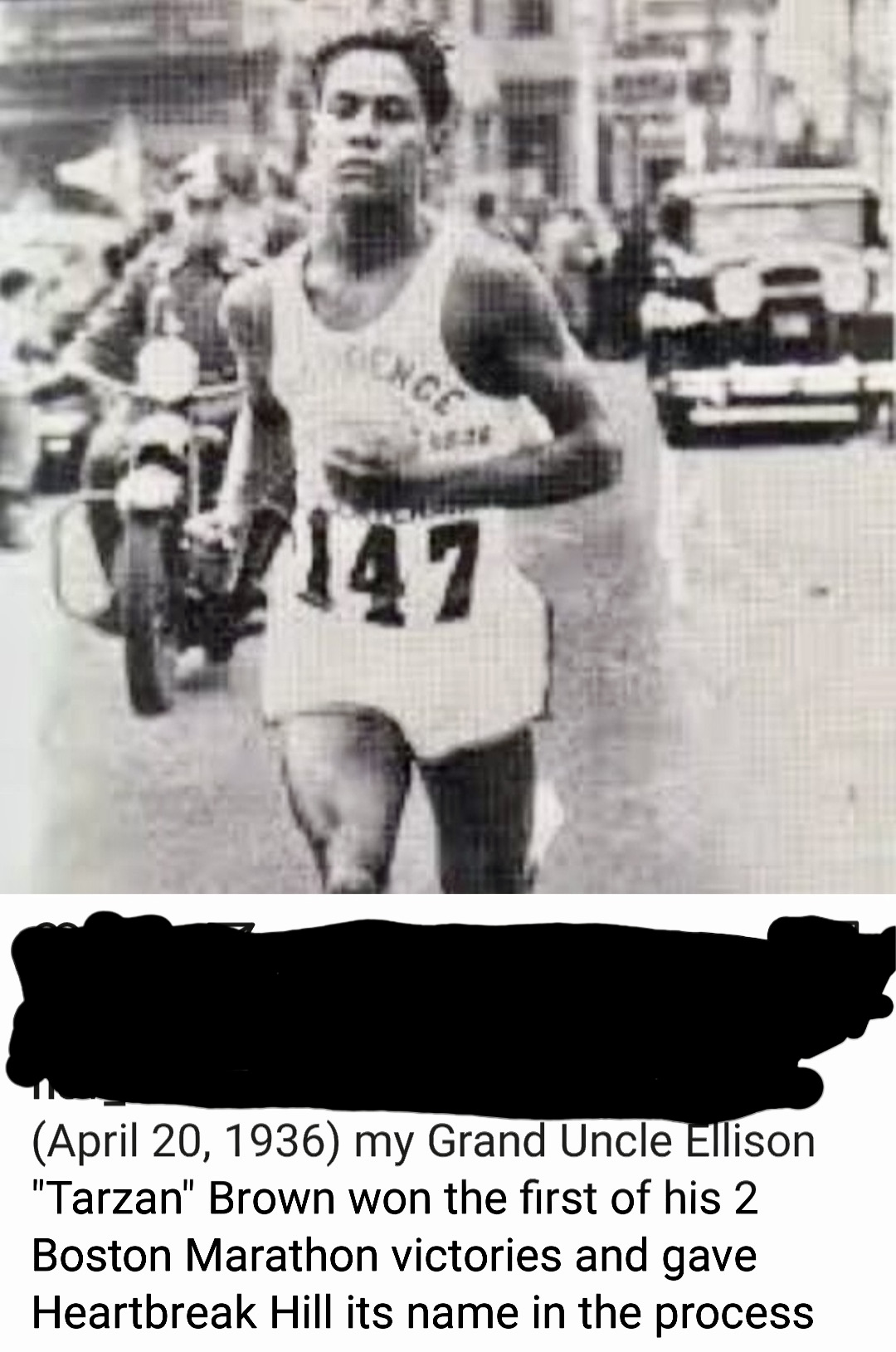
Brian Lightfoot Brown*, son of Patricia (Riley) Brown, has called our attention to the Boston Marathon’s recognition of Indigenous Peoples Day as a federal government holiday. In doing so, the Boston Marathon is honoring Brian’s grand uncle the late Ellison “Tarzan” Brown (1913-1975) of the Narraganset Tribe, who twice won the Boston Marathon.
Here is a copy of a photo Brian sent along to 19pondstreet.
I have included a previous Associated Press news article which was published in September – prior to today’s event.
“BOSTON (AP) — Organizers of the Boston Marathon publicly apologized for running the 125th edition of the planet’s most celebrated footrace on Indigenous Peoples Day.
Now they’re seeking to make amends by throwing the spotlight on a member of Rhode Island’s Narragansett tribe who won the race twice in the 1930s and inspired the name “Heartbreak Hill” to describe the most iconic — and dreaded — section of the course.
The Boston Athletic Association, which administers the marathon, said Monday it will honor the legacy of the late Ellison “Tarzan” Brown, Boston’s champion in 1936 and 1939, in the run-up to the race’s pandemic-altered Oct. 11 staging.
The Boston Marathon traditionally is held in mid-April on Massachusetts’ unique Patriots’ Day holiday. In 2020, it was canceled in its traditional format for the first time because of the coronavirus pandemic, and because of a resurgence of COVID-19 cases, it’s being run this year in the autumn rather than the spring.
Next month’s running falls on Indigenous Peoples Day — observed in some places as an alternative to Columbus Day — and that rankled enough people for the BAA in August to issue “sincere apologies to all Indigenous people who have felt unheard or feared the importance of Indigenous Peoples’ Day would be erased.”
Massachusetts does not officially recognize Indigenous Peoples Day, but Newton — which lies on the marathon course — does.
Eighty-five years after his historic first win, Brown’s descendants cheered the recognition of their acclaimed ancestor.
“Running and winning the Boston Marathon was something grandpa loved,” said Anna Brown-Jackson, a granddaughter of Brown.
“Being an Indigenous person meant everything to Grandpa because he was very competitive to begin with,” she said. “If someone told him he couldn’t do something, whether it was winning the marathon or crossing through a path of land to gather shellfish for his family, he’d make sure to prove them wrong and do it.”
Patti Catalano Dillon, a member of the Mi’kmaq tribe, a three-time Boston Marathon runner-up and a former American marathon record holder, also will be honored at next month’s race.
Brown, whose tribal nickname was Deerfoot, set a world record with his second victory at Boston and represented the U.S. in Hitler’s 1936 Olympics in Berlin alongside the great Jesse Owens.
But he’s best known for bursting onto America’s nascent distance running scene in his initial victory in 1936, when multiple Boston champion Johnny Kelley was heavily favored to win.
Media reports from 1936 say Brown had established a commanding lead in the 26.2-mile (42.2-kilometer) race when Kelley caught him near the 20-mile (32-kilometer) mark in the Newton hills. Kelley, it’s said, gave Brown a patronizing pat on the back as if to say, “Nice try — I’ll take it from here.”
That backfired badly. Brown took off, leaving Kelley in his dust and breaking his heart.
“He ran like a bat out of hell,” The Boston Globe reported at the time. Brown won in 2 hours, 33 minutes, 40 seconds; three years later, in his second win, he was the first to break 2:30 with a time of 2:28:51.
Brown became an instant hero to native people across North America. But like other top Indigenous athletes of his era, he struggled greatly with discrimination and marginalization.
In 1975, he died at age 60 after he was deliberately run over by a car in the parking lot of a Rhode Island bar.
___
Follow AP New England editor Bill Kole on Twitter at https://twitter.com/billkole.“

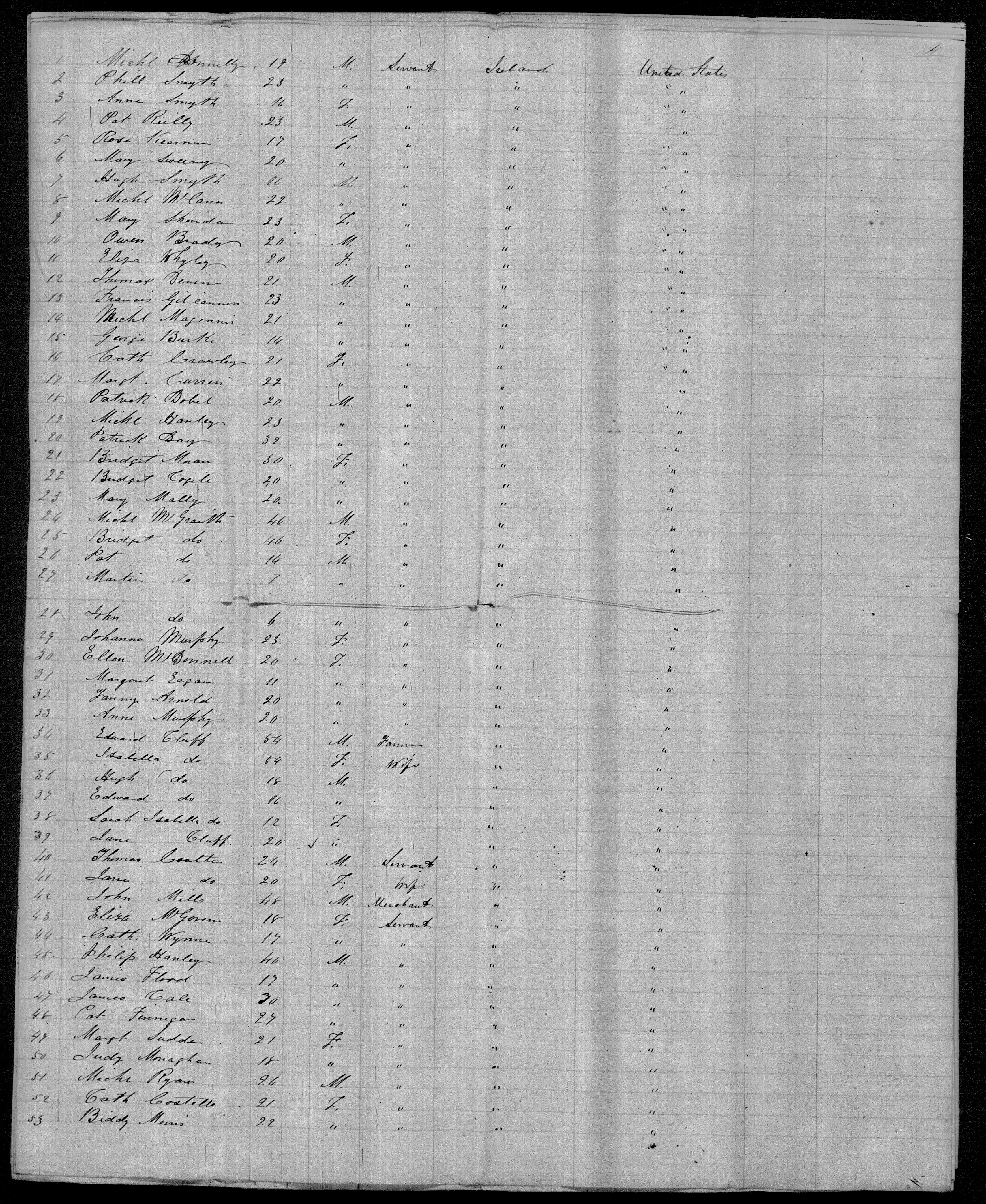
Patrick Reilly and Rose Kearnan departed the passenger ship Neptune and stepped out onto America’s New York City. Patrick was 23 and Rose(a) was 17 years of age.
Patrick’s father’s name was Michael and Catherine was his mother. Rose’s parents were named Patrick Kiernan and Rose (McHugh) Kiernan,
The Neptune left out of Liverpool, England sometime around the middle of May,1862 and sailed directly into New York harbor. Back in 1862, depending upon the type of vessel and weather, the Atlantic crossing could have lasted up to fourteen days.
Passengers departed the ship according to the class of their tickets. The holders of the First Class tickets disembarked first, Second Class next, and finally the people in steerage who were the last to leave the ship. An examination of the manifest shows Patrick and Rose were listed on the last page. At the time of their crossing, the cost of the cheapest ticket would have been around the equivalent of $39.
Here is a photo copy of the last page Neptune’s passenger manifest. You can just make out numbers 4 and 5 – Pat Reilly and Rose Kearnan (sp).
Most people think that on March 17th we celebrate Saint Patrick’s birthday, but that’s not the case. In 461 A.D., Saint Patrick, the Christian missionary, bishop and apostle of Ireland, died at Saul, Downpatrick, Ireland (now Northern Ireland).
The History Channel tells us, (what better source is there?) Patrick was “born in Great Britain, probably in Scotland, to a well-to-do Christian family of Roman citizenship, Patrick was captured and enslaved at age 16 by Irish marauders. For the next six years, he worked as a herder in Ireland, turning to a deepening religious faith for comfort. Following the counsel of a voice he heard in a dream one night, he escaped and found passage on a ship to Britain, where he was eventually reunited with his family.
According to the Confessio, in Britain Patrick had another dream, in which an individual named Victoricus gave him a letter, entitled ‘The Voice of the Irish.’ As he read it, Patrick seemed to hear the voices of Irishmen pleading him to return to their country and walk among them once more. After studying for the priesthood, Patrick was ordained a bishop. He arrived in Ireland in 433 and began preaching the Gospel, converting many thousands of Irish and building churches around the country. After 40 years of living in poverty, teaching, traveling and working tirelessly, Patrick died on March 17, 461 in Saul, where he had built his first church.”
Typical, celebrating death seems to have always been a specialty of the Irish.
A Bit of Trivia
Whispered at many a gathering or even in a family parlor, ” Oh, geez, not another one named Patrick.” Well, in our Riley family tree and its branches, the name Patrick has been scribbled on birth and christening certificates many a time. My father, a Patrick himself, used to say the name was chosen because of the family’s lack of imagination. But, according to the Irish genealogical website I follow, A Letter From Ireland , that might not necessarily be the case.
A Letter From Ireland states, “It has been a tradition in Ireland for many centuries, that anyone born in the month of March has a good chance of being given the name Patrick or Patricia.
That was not always so. Right up until the early 1700s, Patrick was considered too saintly a name to be taken by the masses. That, of course, has changed. By the 1901 census there were almost 300,000 Patricks on the island but only 173 Patricias – the use of the female version is quite a recent development.
In Ireland today, there are almost “40 shades” of Patrick and Patricia:
For Patrick, you will find: Pádraig, Páraic, Paudie, Padge, Pauric, Podge, Pat, Paddy, Patsy and Pa (substitute an “aw” sound for the Irish “á” – that should sound about right).
For Patricia, you will find: Pat, Patsy, Tricia, Trish, Pádraigín and Patrice (for some reason, Patty never caught on here in Ireland).”
So You Say You’re Looking For An Irish Film…
Here’s a random list:
Beannachtaí na Féile Pádraig ort! (Ban-nock-tee na fayla pawd-rig urt).
Saint Patrick’s Day Blessings on you – and all of your family!
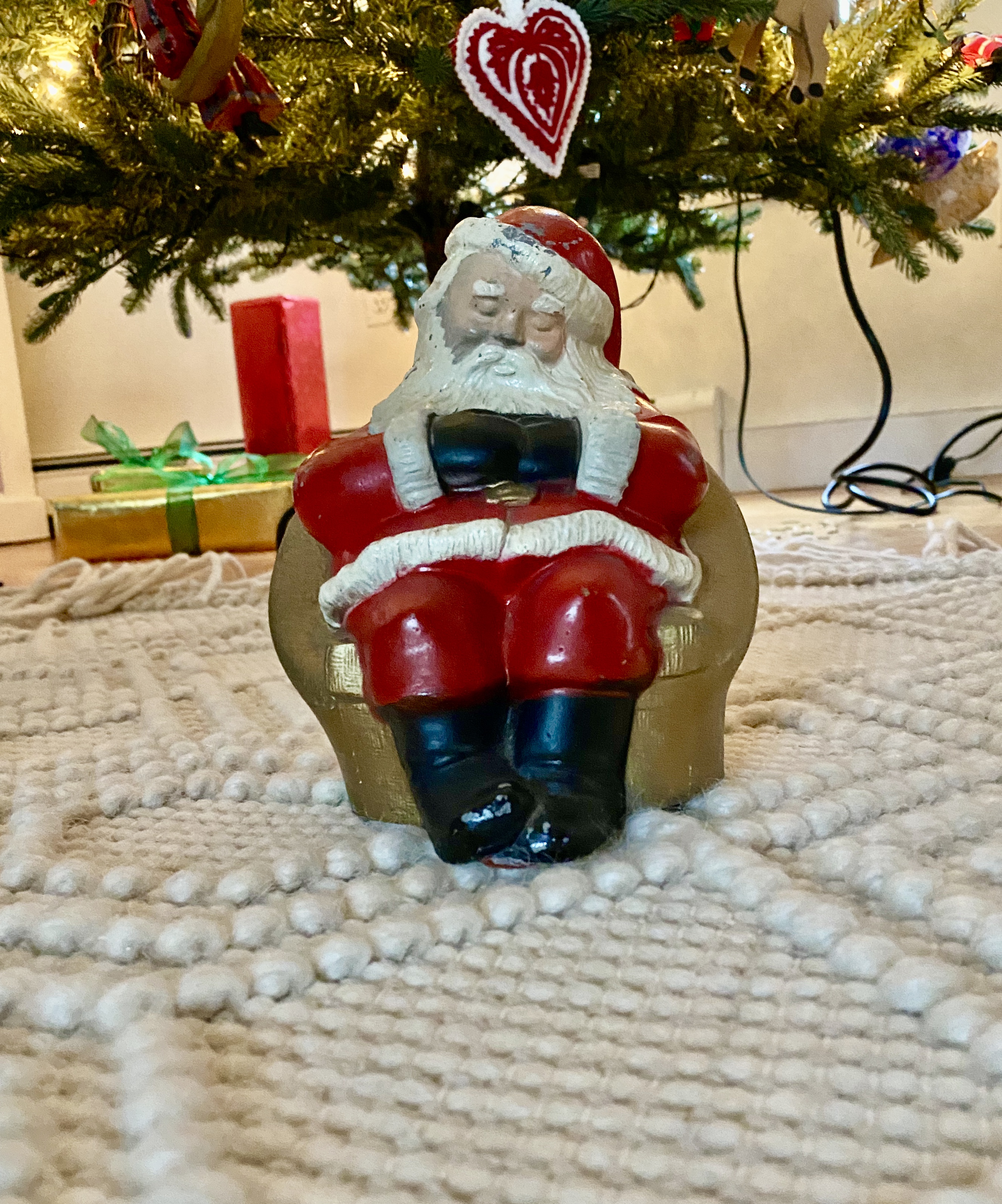
Every year Kathy places the Santa bank that my aunts Marion and Gertie gave to me under our Christmas tree. I think I was five years old when I received their gift. Here is a picture of it sitting under our present tree.
The gift that I have kept the longest is this maple rocking chair. It was gifted to me by Grandma Riley (1876-1962) on Christmas Day in 1949. My mother wrote the information on the bottom of the chair.


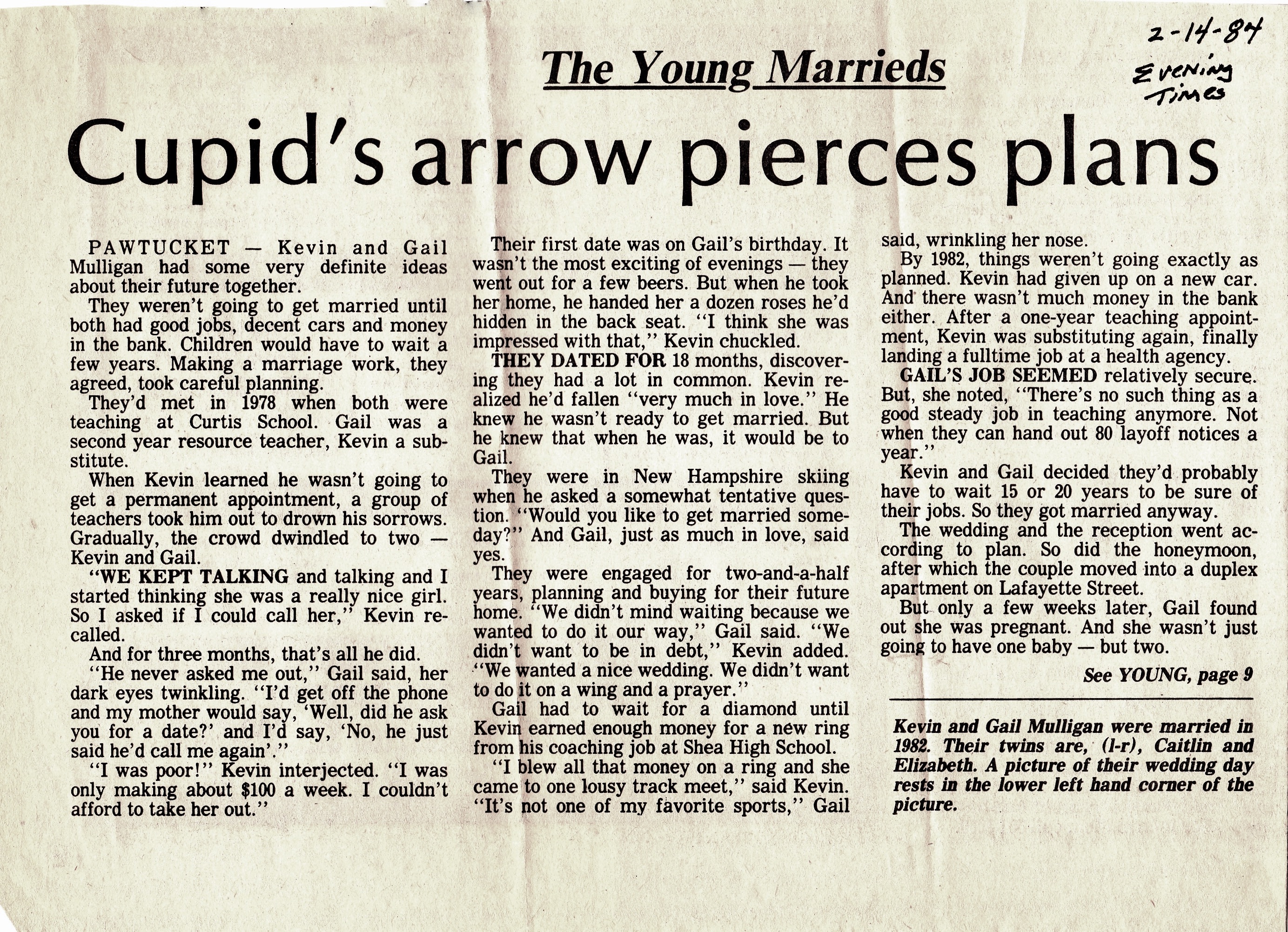
Gail (Benoit) Mulligan, who is married to Kevin FX Mulligan, has a birthday today. We hope Gail is relaxing and enjoying the day, because through the years she has been immersed in several careers . Gail, mother of twins, has been a teacher and an administrator in the Pawtucket School Department. She is now a retiree and part-time baby sitter for her two grandsons. Hopefully, later on today, Kevin will be cooking up her favorite meal to be served along with a glass of Gail’s favorite wine.
Here is an article from the Pawtucket Evening Times that was published on Valentine’s Day back in 1984. It wouldn’t surprise me to find out that Kevin had arranged for this story to be in the paper on February 14th in lieu flowers and chocolates!
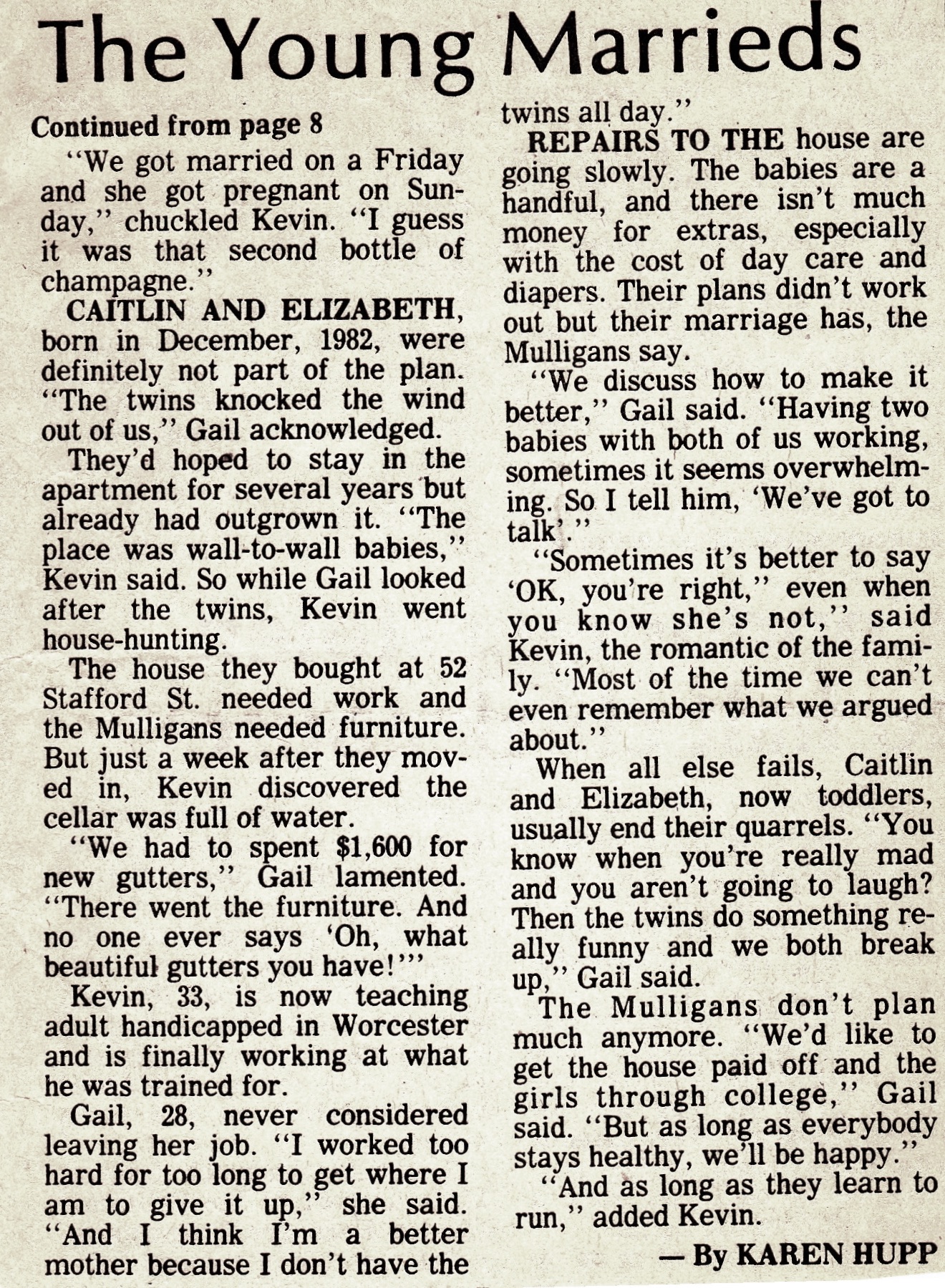
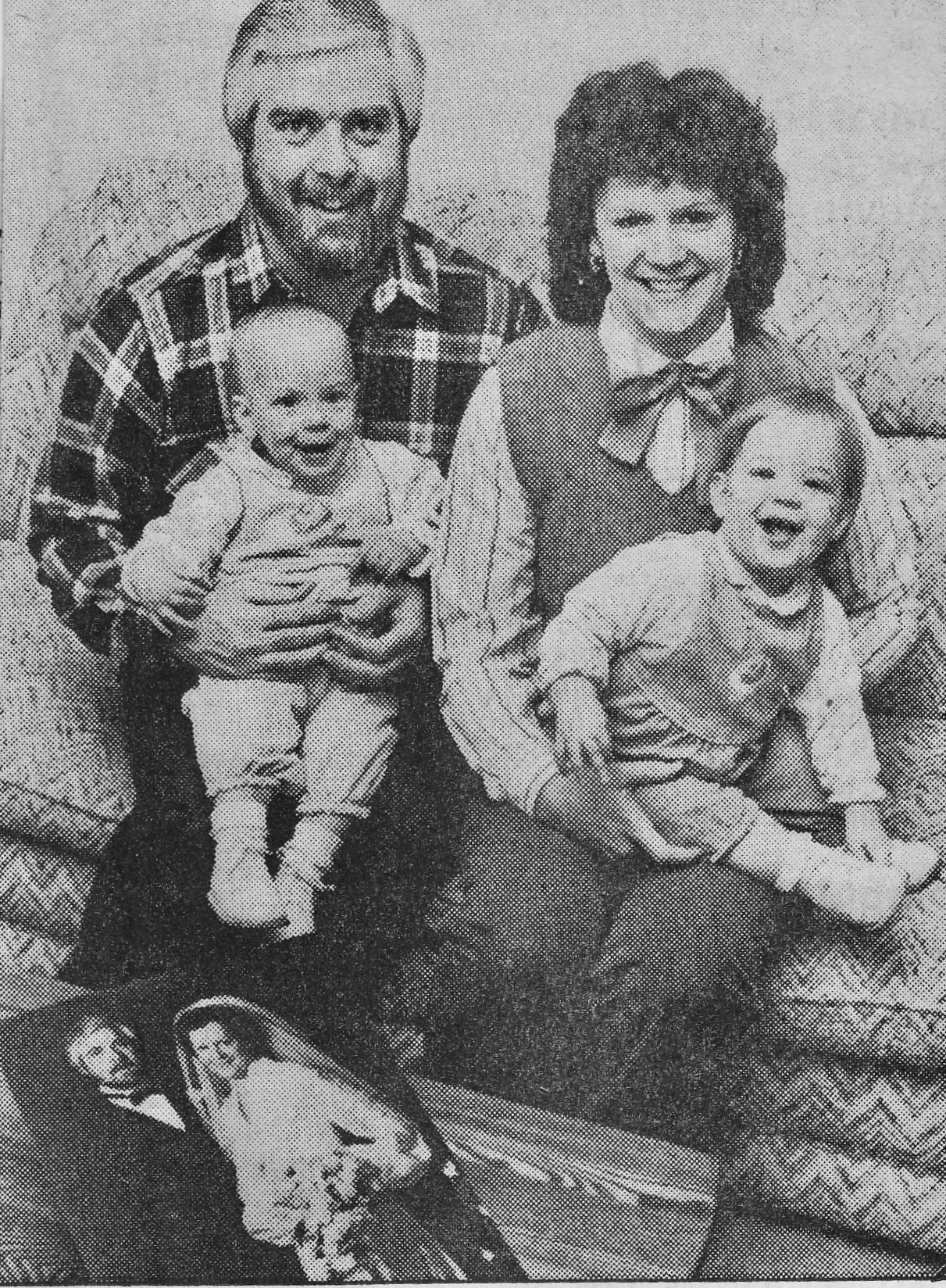
Kevin and Gail with Elizabeth and Caitlin
Happy Birthday, Gail!
Just finished reading the book, The Seine, The River That Made Paris, by Elaine Sciolino.* In it, the author has a chapter which features a family named Fleury, their land, vineyard and their champagne production.
The Fleury vineyard is located in the Seine Valley near the village of Courteron, about a 3 hour drive southeast of Paris and right by the head waters of the Seine. The 37 acre vineyard has been in operation since 1894 with four generations of Fleury working the land.
What makes the Fleury champagne special is the method of farming utilized in the vineyard. According to author Sciolino, in 1989 vintner, Jean-Claude Fleury began to employ “biodynamic farming” which “centers on respect for the earth’s ecosystems” and improves photosynthesis.
Click here to connect to the Fleury Vineyard website. It maybe one of the few ways we can travel now-a-days.
Here is a photo of the Fleury storage facility.

By the way, if you are in any measure of a Francophile or have visited Paris, Elaine Sciolino’s book would be an enjoyable read.
*Sciolino, E. (2020). The Seine, The River That Made Paris (1st.ed) New York, NY: W.W. Norton, Inc. [ISBN 978-0-393-60935-6]
Brian Lightfoot Brown, son of Patricia Riley Brown and Keith Romaine Brown, grandson of William Leo Riley (1912-1985) and Helen (Manning) Riley (1921-1994) was born in Westerly, Rhode Island but grew up in Pawtucket.#
Brian is now living in the Phoenix, Arizona area, but as you can read from a recent posting, Brian still feels Pawtucket’s strong emotional tug. I thought it would be nice to include his own words in today’s birthday acknowledgement. Brian’s words not only verify the adage, “A house is a home,” but are a loving reference to his grandfather, William, who was born 108 years ago on July 24th.
“So the house I grew up in is for sale. The house was perfectly placed between Memorial Hospital and McCoy Stadium. I grew up on Arch Street in Pawtucket, Rhode Island. My maternal grandparents bought this house in March of 1954, when my Mother was just 6 months old. Both grandparents were from Pawtucket, but this house was more in my Grandfather’s stomping grounds. My Grandparents added 2 sons to the household and raised their family at 81 Arch Street. I recall many visits to see my Grandparents. In 1979, my parents got divorced and my Mother moved back in with my Grandparents, but with my younger brother and I in tow. My Mom’s youngest brother still lived at home, finishing college at that time. This was my home, my Mother’s home before that. My Grandfather built a shed in the backyard, literally finishing it merely 2 weeks or so before his death in 1985. This was the house where I was raised. The backyard where I played baseball with friends and where my high school graduation party was held in 1992. My Grandmother held on to the house until her death in 1994. My Uncle then moved out, it was just my Mom, my brother and I in the house now. My brother and I were just getting into our young adult years, cracking into our 20s. But then in 1999, we had to give up the house and move. This has honestly disturbed me ever since. A few months after we moved out, a high school acquaintance of my brother’s bought the house. It was unnerving to see someone living there, but what could we do. Years later, it appeared that the owners moved out and were renting the home but made some renovations and yesterday, my brother showed me photos and that our childhood home is for sale. Oh how I wish I could afford it. I have vowed that if I ever come into enough money, I will buy this house back. It will be a chip on my shoulder until the day comes when my family owns this house, or until I take my last breath on this earth. There is no “getting over it, I will always long for reconnection to this house, end of story.”
Happy Birthday, Brian! May you be blessed with a powerful air conditioner. In Phoenix, the high temp is expected to be 100 with a low of 85 on your special day.

It was just about 10:15 am 50 years ago today on June 20, 1970 that Paula Marie Mulligan and John Steven Kostycz were united in the Holy Sacrament of Matrimony.
St Joseph’s Church on Walcott Street in Pawtucket had a pretty good turnout to see the Mulligan girl marry this John fellow from the Mid-West. The sky was clear. The temperature was a nice 66 degrees and the humidity was quite low. They said it was a perfect day for the perfect bride! The Mulligans, the Rileys, friends and even those Kostyczs from Chicago were there. I wasn’t there (finishing up at college in Wisconsin), but I bet Walter was.
Here are some photos from from Paula and John’s special day.

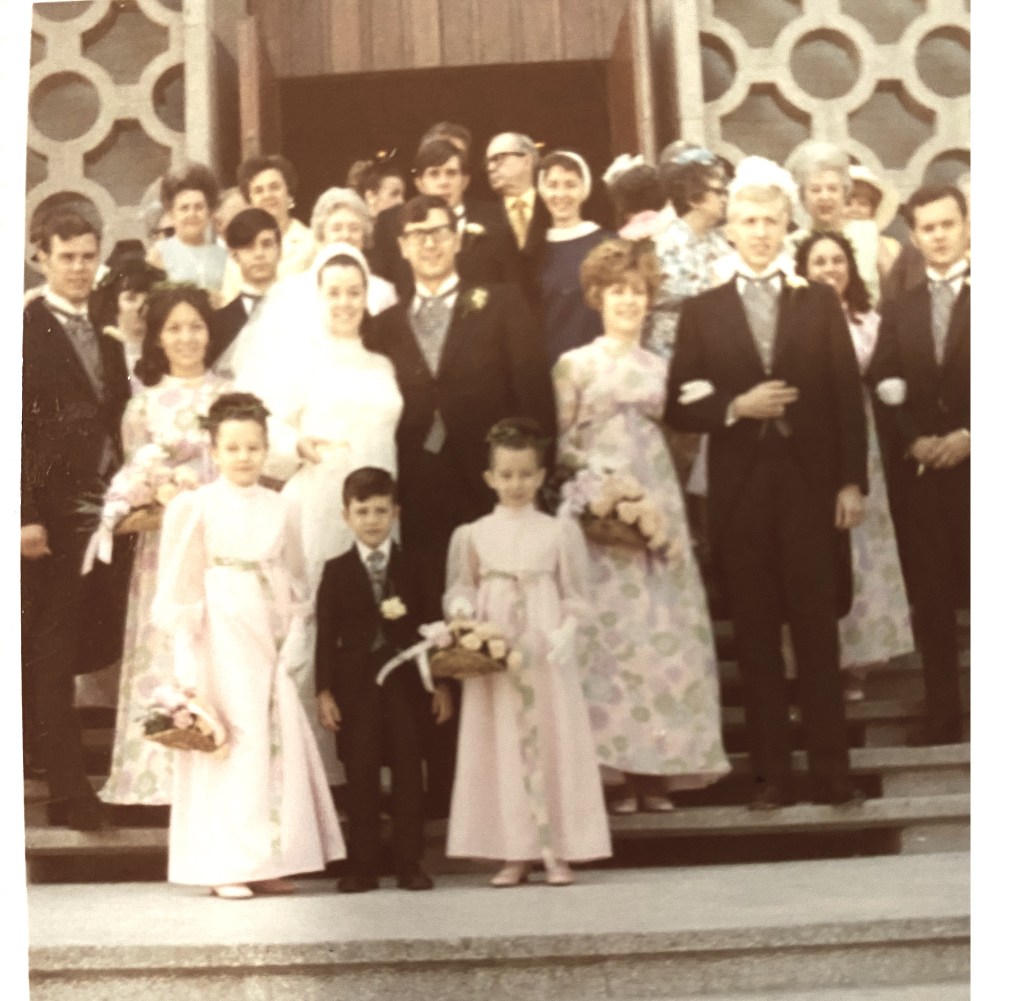
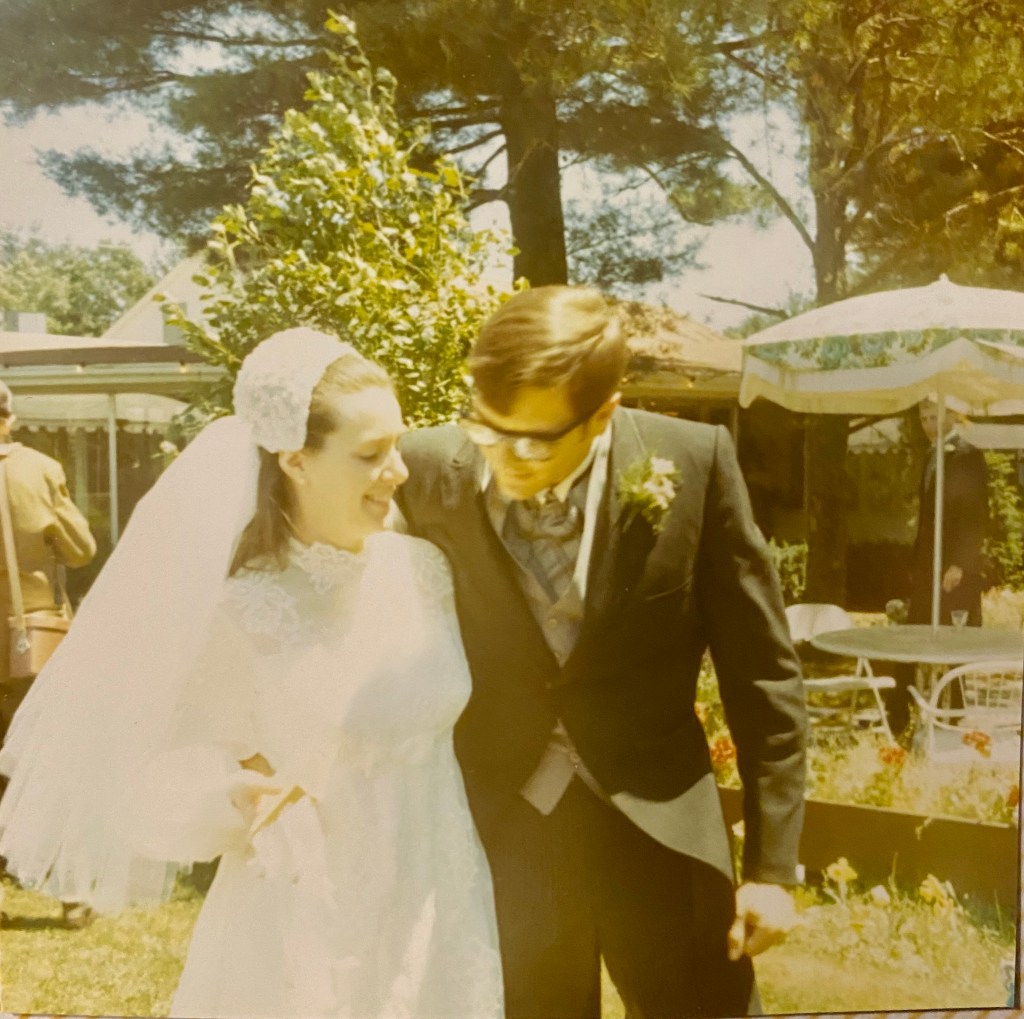
Let’s all lift an appropriate libation to Paula and John on this occasion of their 50th Wedding Anniversary.
The 10:15 am temperature this morning in Florida, where the Kostyczs now live, is 87 degrees with a humidity reading of 70%. Just goes to show that John and Paula can still bring the heat!
Special thanks to Paula’s niece, Susan Moore and to Kevin FX Mulligan for the heads up and the pictures.
Jacob Richard Ferreira was born on this day in Providence to Staci Fleury and Michael Ferreira. Jacob’s grandparents (on the Riley side) are Darleen and Richard (Rick) Fleury.
As a six year old, Jacob is probably not that interested that his Birthday is being acknowledged on the blog. Today his attention is most likely focused elsewhere on things like cake, ice cream, a party, a present or two and having a good time. After all, it is his special day.
It’s a great time for the Ferreiras and the Fleurys to celebrate, to look forward to what is to come and to review what has been. Also, this gives 19pondstreet the opportunity to introduce a new generation, a 6th generation of Americans. Jacob, his brother Zachary, and their four cousins can trace themselves back to May 28, 1862, when Pat Reilly and Rosa Kearnan walked down The Neptune’s gangplank and stepped out into New York City.
Here is the generational line:
1st gen – Patrick Leo Riley (1875-1955) – Patrick and Rosa’s son
2nd gen – Patrick Joseph Riley (1900-1985)
3rd gen – Barbara Hope Riley Fleury (1927-2015)
4th gen – Richard B. Fleury, Jr
5th gen – Staci Fleury Ferreira
6th gen – Jacob Richard Ferreira
Bet Patrick and Rosa would probably say those fourteen days spent in Neptune’s steerage was well worth it.

Given that today is Memorial Day, and since this National Day of Remembrance has its origins back to the time of the Civil War, I thought you would enjoy viewing the attached photo.
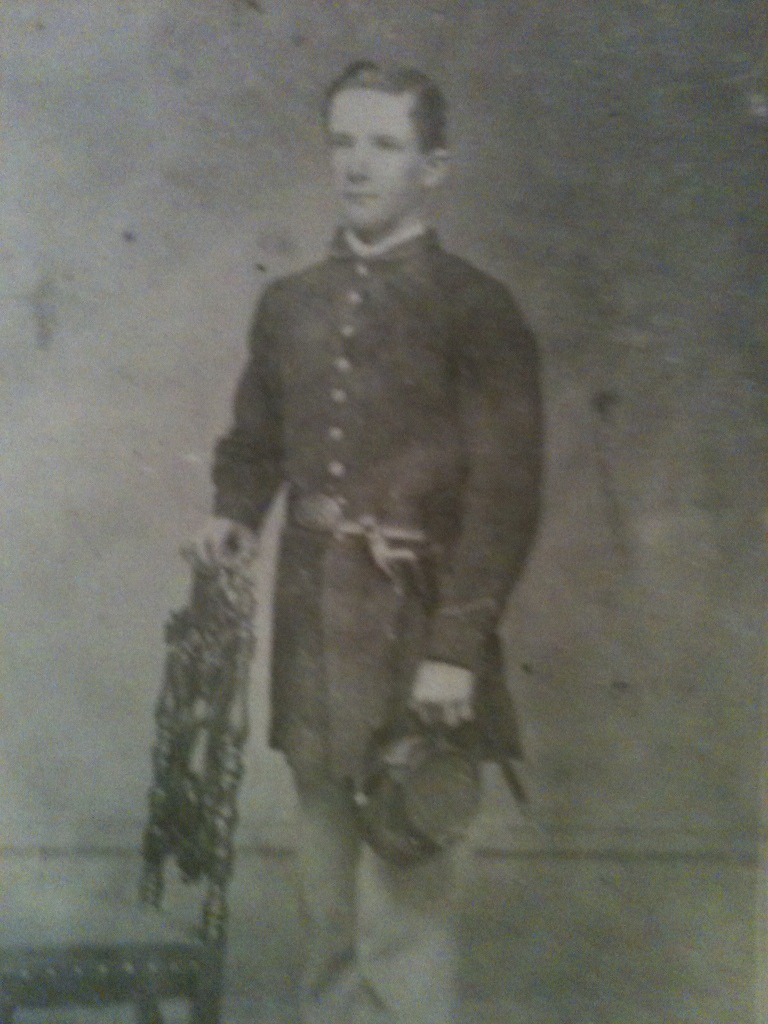
John Greenhalgh (1845-1907) was “Grandma Riley’s (Margaretta Greenhalgh Riley (1876-1962) father, which makes him my great-grandfather.
May he Rest In Peace
[I have “borrowed” the image from Erik Volk, a fellow Ancestry member who has done research on the Greenhalgh family.]
MAR 17, 2019
St. Patrick may be the patron saint of Ireland, but many St. Patrick’s Day traditions were born in the United States.CHRISTOPHER KLEIN
Every March 17, the United States becomes an emerald country for a day. Americans wear green clothes and quaff green beer. Green milkshakes, bagels and grits appear on menus. In a leprechaun-worthy shenanigan, Chicago even dyes its river green.
Revelers from coast to coast celebrate all things Irish by hoisting pints of Guinness and cheering bagpipers, step dancers and marching bands parading through city streets. These familiar annual traditions weren’t imported from Ireland, however. They were made in America.

In contrast to the merry-making in the United States, March 17 has been more holy day than holiday in Ireland. Since 1631, St. Patrick’s Day has been a religious feast day to commemorate the anniversary of the 5th-century death of the missionary credited with spreading Christianity to Ireland. For several centuries, March 17 was a day of solemnity in Ireland with Catholics attending church in the morning and partaking of modest feasts in the afternoon. There were no parades and certainly no emerald-tinted food products, particularly since blue, not green, was the traditional color associated with Ireland’s patron saint prior to the 1798 Irish Rebellion.
READ MORE: St. Patrick’s Day Myths Debunked
Boston has long staked claim to the first St. Patrick’s Day celebration in the American colonies. On March 17, 1737, more than two dozen Presbyterians who emigrated from the north of Ireland gathered to honor St. Patrick and form the Charitable Irish Society to assist distressed Irishmen in the city. The oldest Irish organization in North America still holds an annual dinner every St. Patrick’s Day.
Historian Michael Francis, however, unearthed evidence that St. Augustine, Florida, may have hosted America’s first St. Patrick’s Day celebration. While researching Spanish gunpowder expenditure logs, Francis found records that indicate cannon blasts or gunfire were used to honor the saint in 1600 and that residents of the Spanish garrison town processed through the streets in honor of St. Patrick the following year, perhaps at the behest of an Irish priest living there.
Ironically, it was a band of Redcoats who started the storied green tradition of America’s largest and longest St. Patrick’s Day parade in 1762 when Irish-born soldiers serving in the British Army marched through lower Manhattan to a St. Patrick’s Day breakfast at a local tavern. The March 17 parades by the Irish through the streets of New York City raised the ire of nativist, anti-Catholic mobs who started their own tradition of “paddy-making” on the eve of St. Patrick’s Day by erecting effigies of Irishmen wearing rags and necklaces of potatoes with whiskey bottles in their hands until the practice was banned in 1803.
After Irish Catholics flooded into the country in the decade following the failure of Ireland’s potato crop in 1845, they clung to their Irish identities and took to the streets in St. Patrick’s Day parades to show strength in numbers as a political retort to nativist “Know-Nothings.”
“Many who were forced to leave Ireland during the Great Hunger brought a lot of memories, but they didn’t have their country, so it was a celebration of being Irish,” says Mike McCormack, national historian for the Ancient Order of Hibernians. “But there was also a bit of defiance because of the bigotry by the Know-Nothings against them.”
McCormack says attitudes toward the Irish began to soften after tens of thousands of them served in the Civil War. “They went out as second-class citizens but came back as heroes,” he says. As the Irish slowly assimilated into American culture, those without Celtic blood began to join in St. Patrick’s Day celebrations.
The meal that became a St. Patrick’s Day staple across the country—corned beef and cabbage—was also an American innovation. While ham and cabbage was eaten in Ireland, corned beef proved a cheaper substitute for impoverished immigrants. McCormack says corned beef became a staple of Irish-Americans living in the slums of lower Manhattan who purchased leftover provisions from ships returning from the tea trade in China.
“When ships came into South Street Seaport, many women would run down to the port hoping there was leftover salted beef they could get from the ship’s cook for a penny a pound,” McCormack says. “It was the cheapest meat they could find.” The Irish would boil the beef three times—the last time with cabbage—to remove some of the brine.

While St. Patrick’s Day evolved in the 20th century into a party day for Americans of all ethnicities, the celebration in Ireland remained solemn. The Connaught Telegraph reported of Ireland’s commemorations on March 17, 1952: “St. Patrick’s Day was very much like any other day, only duller.” For decades, Irish laws prohibited pubs from opening on holy days such as March 17. Until 1961, the only legal place to get a drink in the Irish capital on St. Patrick’s Day was the Royal Dublin Dog Show, which naturally attracted those with only a passing canine interest.
The party atmosphere only spread to Ireland after the arrival of television when the Irish could see all the fun being had across the ocean. “Modern Ireland took a cue from America,” McCormack says. The multi-day St. Patrick’s Day Festival, launched in Dublin in 1996, now attracts one million people each year.
The Irish are now adopting St. Patrick’s Day traditions from Irish America such as corned beef and cabbage, McCormack says. There are some American traditions, however, that might not catch on in Ireland, such as green Guinness. As McCormack says, “St. Patrick never drank green beer.”
BY CHRISTOPHER KLEIN is the author of four books, including When the Irish Invaded Canada: The Incredible True Story of the Civil War Veterans Who Fought for Ireland’s Freedomand Strong Boy: The Life and Times of John L. Sullivan. His work has appeared in numerous publications, including The Boston Globe, The New York Times, and National Geographic Traveler. Follow Chris on Twitter @historyauthor.
Andrew Greenhalgh was born on this day in 1879 in Lonsdale, Rhode Island to the late Margaret Cullen (1848-1915) and the late John Greenhalgh (1845-1907).
This is the first time that a Greenhalgh has been featured in this blog. Why so? Well, one of Andrew’s five siblings was Marguetta E. (Greenhalgh) Riley (1876-1962), known by most of the older, present day Rileys as Grandma Riley.
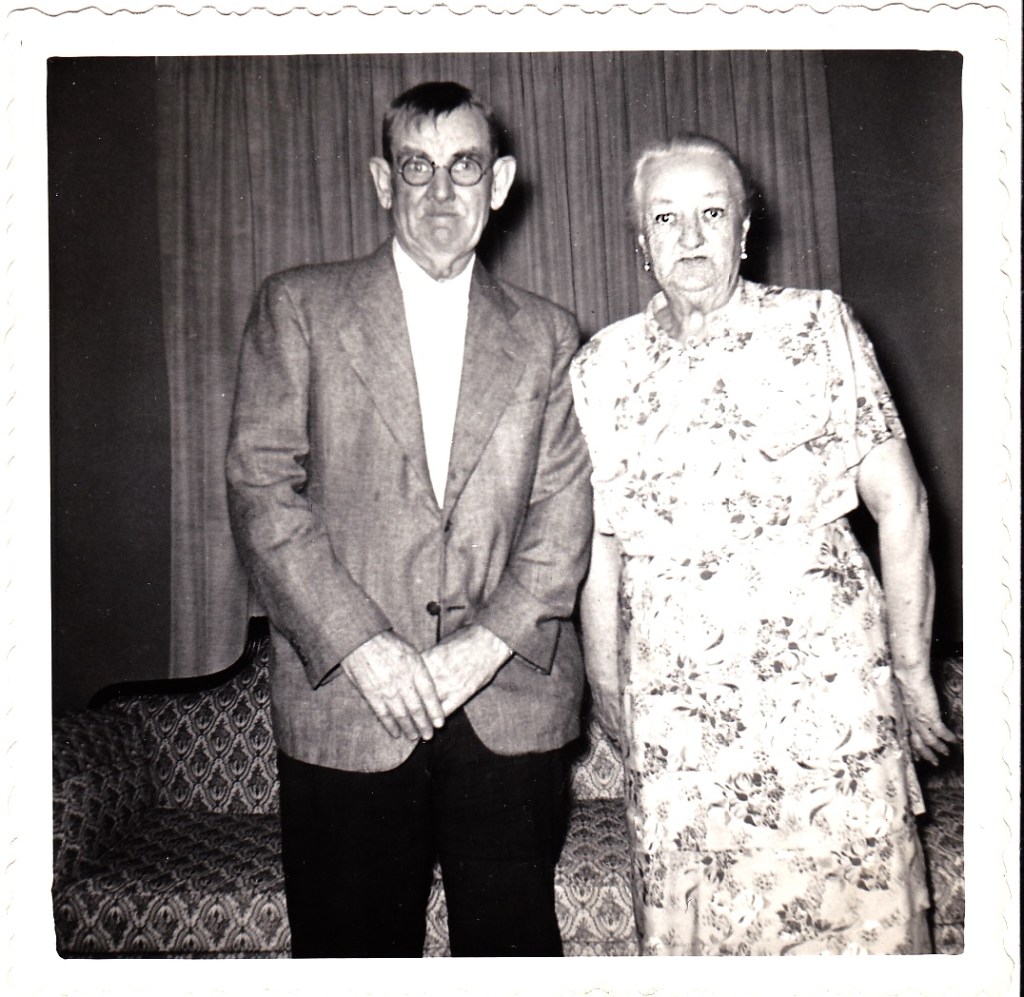
As best as I can remember, Uncle Andrew was “a presence” at #19-21 Pond Street. After checking the census records and the city directories, it appears Uncle Andrew began living with the Pond Street Rileys sometime in 1935. He remained in-residence, and an integral part of the family, until his death in 1962.
However during World War II, Uncle Andrew spent time in Waterbury, Connecticut. At the age of 61, Andrew went there to work in a factory in support of the War effort. A printer by trade, he utilized those skills in his factory job. At the time, Andrew lived with his fellow workers in an open dormitory type setting at the Waterbury Boys’ Club.
Back in the early 1940’s, working toward the War effort was the routine. What made Uncle Andrew’s effort noteworthy was his physical handicap. When he was a child, Andrew fell off the back of a tip cart

and severely injured his right leg, resulting in a permanent handicap. For the rest of his life, his leg was encased in a heavy metal brace that ran from just above his knee to the bottom of his shoe. It looked like it weighed a ton.
The brace may have slowed him down a bit, but didn’t stop him. Uncle Andrew’s prized possessions were his huge cars fully equipped with hand controls. If I remember correctly, he braked with his left leg, while the speed and shifting were controlled with hand levers. His automobiles always had lots of chrome and large, decorative continental kits hanging off the back. The cars had lots of color and personality, something that some say Uncle Andrew lacked.
When I was growing up, whenever there would be a reference to Andrew, the referring phrase would always be, “Poor Uncle Andrew.” It was said in obvious sympathy, because of the physical struggles he endured. Through the years, Grandma Riley, along with Marion and Gertie, really went to great lengths to support and encourage him. Being a printer by trade, and never owning his own business, his financial well-being wasn’t the best. He was supported and augmented financially by his nieces Marion and Gertie. It was very typical of his two kind nieces.
In 1962, on a Sunday morning, a couple of weeks after Uncle Andrew’s passing, the task of going through his belongings fell to his nephews, Patrick J. and Francis C. Riley. There weren’t many clothes and just a few personal items. At the foot of his bed was an old trunk, which his two nephews had to pry open with a hammer and screwdriver. As they were sorting through the last of his worldly possessions, the sympathetic and endearing phrase of “Poor Uncle Andrew” took an unsuspected twist. Low and behold, the trunk held some neatly tied stacks of cash! Seems Poor Uncle Andrew had been stashing away cash for a rainy day – or year. The exact amount may have been north of $30,000. The then, laughing brothers turned the money back over to Marion and Gertie…heck, it was probably their own money.
Poor Uncle Andrew.
 19 Pond Street