It was on this May 28th day in 1862 that Patrick Riley and Rose Kiernan set foot in the United States.
Patrick and Rose first left Ireland and traveled to Liverpool, England. I do not know how long they stayed in Liverpool. It was typical for the emigrating Irish to first book passage to Liverpool, where they would hopefully gain employment and secure enough money to purchase passage to New York. Patrick and Rose did not process through Ellis Island because it was not established as an arrival center. We can determine they traveled in steerage class because the passenger list had them in the last group departing the ship.
It appears they were not married at the time because Rose traveled under her maiden name and both were listed as single.
Patrick Reilly and Rose Kearnan departed the passenger ship Neptune and stepped out onto America’s New York City. Patrick was 23 and Rose(a) was 17 years of age.
Patrick’s father’s name was Michael and Catherine was his mother. Rose’s parents were named PatrickKiernan and Rose(McHugh) Kiernan,
The Neptune left out of Liverpool, England sometime around the middle of May,1862 and sailed directly into New York harbor. Back in 1862, depending upon the type of vessel and weather, the Atlantic crossing could have lasted up to fourteen days.
Passengers departed the ship according to the class of their tickets. The holders of the First Class tickets disembarked first, Second Class next, and finally the people in steerage who were the last to leave the ship. An examination of the manifest shows Patrick and Rose were listed on the last page. At the time of their crossing, the cost of the cheapest ticket would have been around the equivalent of $39.
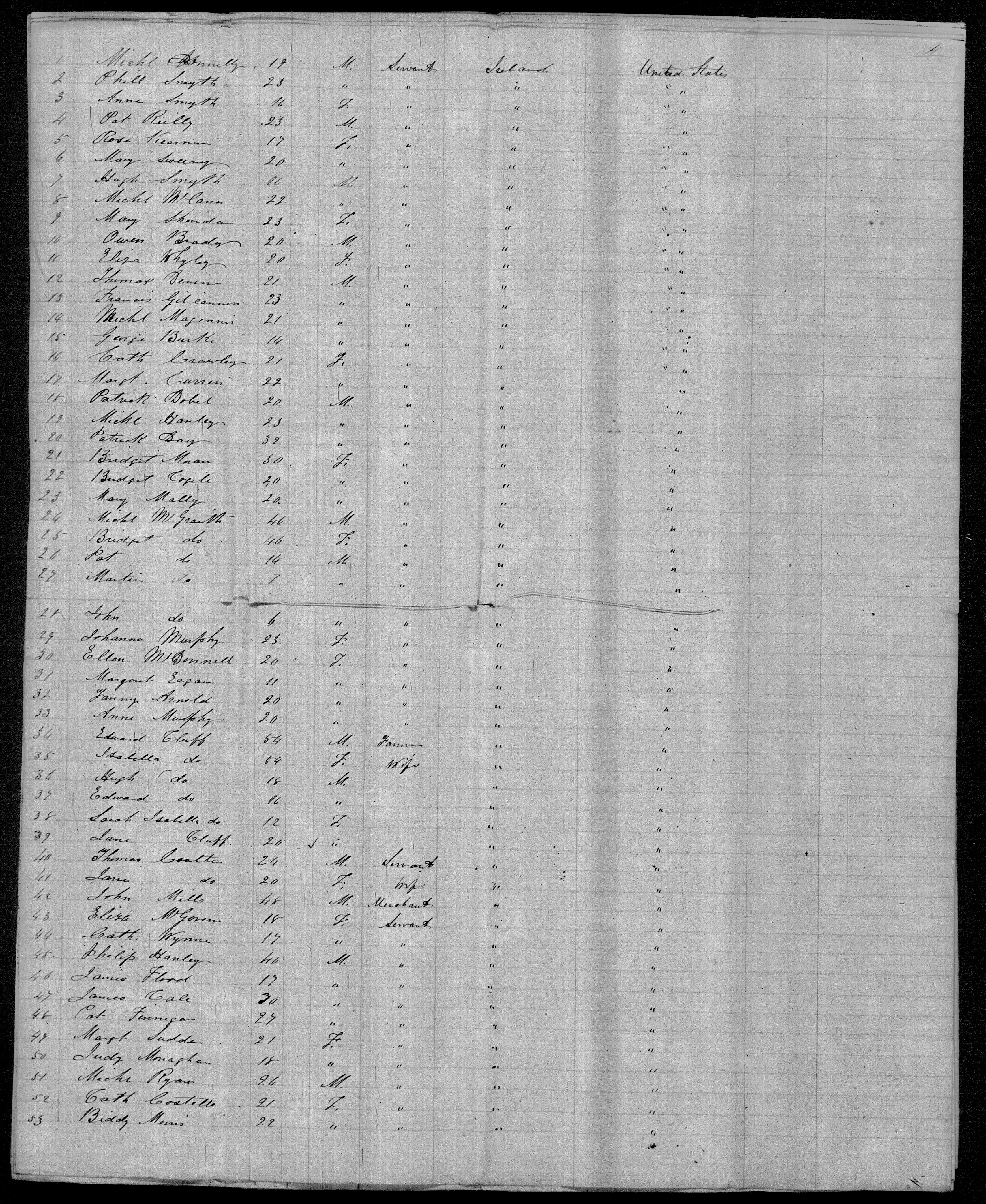
Here is a photo copy of the last page Neptune’s passenger manifest. You can just make out numbers 4 and 5 – Pat Reilly and Rose Kearnan (sp).
Jacob Richard Ferreira was born on this day in Providence to Staci Fleury and Michael Ferreira. Jacob’s grandparents (on the Riley side) are Darleen and Richard (Rick) Fleury.
As a six year old, Jacob is probably not that interested that his Birthday is being acknowledged on the blog. Today his attention is most likely focused elsewhere on things like cake, ice cream, a party, a present or two and having a good time. After all, it is his special day.
It’s a great time for the Ferreiras and the Fleurys to celebrate, to look forward to what is to come and to review what has been. Also, this gives 19pondstreet the opportunity to introduce a new generation, a 6th generation of Americans. Jacob, his brother Zachary, and their four cousins can trace themselves back to May 28, 1862, when Pat Reilly and Rosa Kearnan walked down The Neptune’s gangplank and stepped out into New York City.
Here is the generational line:
1st gen – Patrick Leo Riley (1875-1955) – Patrick and Rosa’s son
2nd gen – Patrick Joseph Riley (1900-1985)
3rd gen – Barbara Hope Riley Fleury (1927-2015)
4th gen – Richard B. Fleury, Jr
5th gen – Staci Fleury Ferreira
6th gen – Jacob Richard Ferreira
Bet Patrick and Rosa would probably say those fourteen days spent in Neptune’s steerage was well worth it.
Happy Birthday Jacob. May all your future ride be great!
The following is from a newsletter produced by the HISTORY CHANNEL
St. Patrick may be the patron saint of Ireland, but many St. Patrick’s Day traditions were born in the United States.CHRISTOPHER KLEIN
Every March 17, the United States becomes an emerald country for a day. Americans wear green clothes and quaff green beer. Green milkshakes, bagels and grits appear on menus. In a leprechaun-worthy shenanigan, Chicago even dyes its river green.
Revelers from coast to coast celebrate all things Irish by hoisting pints of Guinness and cheering bagpipers, step dancers and marching bands parading through city streets. These familiar annual traditions weren’t imported from Ireland, however. They were made in America.
St. Patrick’s Day, circa 1860s. Bettmann Archive/Getty Images
In contrast to the merry-making in the United States, March 17 has been more holy day than holiday in Ireland. Since 1631, St. Patrick’s Day has been a religious feast day to commemorate the anniversary of the 5th-century death of the missionary credited with spreading Christianity to Ireland. For several centuries, March 17 was a day of solemnity in Ireland with Catholics attending church in the morning and partaking of modest feasts in the afternoon. There were no parades and certainly no emerald-tinted food products, particularly since blue, not green, was the traditional color associated with Ireland’s patron saint prior to the 1798 Irish Rebellion.
Boston has long staked claim to the first St. Patrick’s Day celebration in the American colonies. On March 17, 1737, more than two dozen Presbyterians who emigrated from the north of Ireland gathered to honor St. Patrick and form the Charitable Irish Society to assist distressed Irishmen in the city. The oldest Irish organization in North America still holds an annual dinner every St. Patrick’s Day.
Historian Michael Francis, however, unearthed evidence that St. Augustine, Florida, may have hosted America’s first St. Patrick’s Day celebration. While researching Spanish gunpowder expenditure logs, Francis found records that indicate cannon blasts or gunfire were used to honor the saint in 1600 and that residents of the Spanish garrison town processed through the streets in honor of St. Patrick the following year, perhaps at the behest of an Irish priest living there.
Ironically, it was a band of Redcoats who started the storied green tradition of America’s largest and longest St. Patrick’s Day parade in 1762 when Irish-born soldiers serving in the British Army marched through lower Manhattan to a St. Patrick’s Day breakfast at a local tavern. The March 17 parades by the Irish through the streets of New York City raised the ire of nativist, anti-Catholic mobs who started their own tradition of “paddy-making” on the eve of St. Patrick’s Day by erecting effigies of Irishmen wearing rags and necklaces of potatoes with whiskey bottles in their hands until the practice was banned in 1803.
After Irish Catholics flooded into the country in the decade following the failure of Ireland’s potato crop in 1845, they clung to their Irish identities and took to the streets in St. Patrick’s Day parades to show strength in numbers as a political retort to nativist “Know-Nothings.”
“Many who were forced to leave Ireland during the Great Hunger brought a lot of memories, but they didn’t have their country, so it was a celebration of being Irish,” says Mike McCormack, national historian for the Ancient Order of Hibernians. “But there was also a bit of defiance because of the bigotry by the Know-Nothings against them.”
McCormack says attitudes toward the Irish began to soften after tens of thousands of them served in the Civil War. “They went out as second-class citizens but came back as heroes,” he says. As the Irish slowly assimilated into American culture, those without Celtic blood began to join in St. Patrick’s Day celebrations.
The meal that became a St. Patrick’s Day staple across the country—corned beef and cabbage—was also an American innovation. While ham and cabbage was eaten in Ireland, corned beef proved a cheaper substitute for impoverished immigrants. McCormack says corned beef became a staple of Irish-Americans living in the slums of lower Manhattan who purchased leftover provisions from ships returning from the tea trade in China.
“When ships came into South Street Seaport, many women would run down to the port hoping there was leftover salted beef they could get from the ship’s cook for a penny a pound,” McCormack says. “It was the cheapest meat they could find.” The Irish would boil the beef three times—the last time with cabbage—to remove some of the brine.
A St. Patricks day postcard, circa 1850. Popperfoto/Getty Images
While St. Patrick’s Day evolved in the 20th century into a party day for Americans of all ethnicities, the celebration in Ireland remained solemn. The Connaught Telegraphreported of Ireland’s commemorations on March 17, 1952: “St. Patrick’s Day was very much like any other day, only duller.” For decades, Irish laws prohibited pubs from opening on holy days such as March 17. Until 1961, the only legal place to get a drink in the Irish capital on St. Patrick’s Day was the Royal Dublin Dog Show, which naturally attracted those with only a passing canine interest.
The party atmosphere only spread to Ireland after the arrival of television when the Irish could see all the fun being had across the ocean. “Modern Ireland took a cue from America,” McCormack says. The multi-day St. Patrick’s Day Festival, launched in Dublin in 1996, now attracts one million people each year.
The Irish are now adopting St. Patrick’s Day traditions from Irish America such as corned beef and cabbage, McCormack says. There are some American traditions, however, that might not catch on in Ireland, such as green Guinness. As McCormack says, “St. Patrick never drank green beer.”
BY CHRISTOPHER KLEIN is the author of four books, including When the Irish Invaded Canada: The Incredible True Story of the Civil War Veterans Who Fought for Ireland’s Freedomand Strong Boy: The Life and Times of John L. Sullivan. His work has appeared in numerous publications, including The Boston Globe, The New York Times, and National Geographic Traveler. Follow Chris on Twitter @historyauthor.
Recently, I was reviewing the information I have on Patrick Riley, who was born in Ireland about 1835 and died in Pawtucket on September 12, 1906. There isn’t much documentation of his early years and some of the information we do have is conflicting. It appears he arrived in New York City on May 28, 1862 and first emerged in Pawtucket, with family in tow, in 1872. It seems bit strange that there is little mention or reference to those 10 years he spent living in and around New York City. Where were he and his young family living? Were they living on their own, or with another branch of the family? Still can’t figure that out.
What gave thought to all of this was a re-reading of the obit of his death in the Evening Times (Pawtucket) on September 12, 1906.
As posted:
“RILEY – In this city, Sept 12th, Patrick Riley. Funeral from his residence, 181 South Bend Street. Saturday Sept 15th. at 8:00 am. Services at St Joseph’s Church. Relatives and friends are invited to attend. New York papers please copy”
What struck me was the last line which called for the New York papers to copy the notice, that is, to post the news of Patrick’s death. To me, that indicates the strong possibility of other Riley family members were still living in the New York City area in 1906. Love to know if that was the case.
I may have found the day Pat Riley/Reilly set foot on United States soil!
Below is a copy of a page from the manifest of the ship, Neptune which arrived in the Port of New York on May 28, 1862. You can see that the first column on the left has number 4, listed as Pat Reilly andnumber 5 is listed as Rose Kiernan.
This document is from the National Archives and Record Administration.
This is a pleasant find, but it has raised a question or two. When the page came up on the screen it was different from all of the other index pages on the microfiche roll. It was the very last page on the roll. Its physical makeup, font and layout was not at all similar to the other twenty some pages which makes me a bit nervous.




 19 Pond Street